
Luxury Italian Houses for sale in Umbria, Italy

Overview of Umbria
Umbria is bordered by Tuscany to the west, Marche to the east and Lazio to the south. Partly hilly and mountainous, and partly flat and fertile with the Tiber valley. Umbria has part of the central Apennines, the highest peak is Monte Vettore on the border with Le Marche, at 2,476 metres. It is one of the few Italian regions without a coastline.
Umbria is crossed by two valleys: Umbra valley stretching from Perugia to Spoleto, and the Tiber Valley from the west to the border with Lazio. The Tiber River forms the approximate border with Lazio.
Lake Trasimeno is central Italy’s largest lake. The area the remains of Etruscan settlements, particularly around Castiglione del Lago, where the loveliness of the natural landscape combines with the romanticism and stillness of the lake.
In the south of Umbria, in the province of Terni there are the Cascate delle Marmore waterfalls, some of the most beautiful in Europe. Cascate delle Marmore run into the River Nera with a spectacular 165 m (541 ft) drop, and are surrounded by lush vegetation. This is the spot for sports lovers who enjoy canoeing, kayaking.
In the province of Terni, there are two locations not to be missed, one linked to the history of Umbria and the other to the landscape. Carsulae is an ancient Roman town traversed by the ancient Via Flaminia, where important ancient public buildings have been discovered The other gem, closely linked to the area’s makeup is the Dunarobba Fossil Forest, a rare example of a petrified forest that existed 3 million years ago, very well-preserved.
Monte Subasio park (Perugia)
Monte Subasio, at 1290 metres, characterises and dominates the splendid valley below, the peaks of Civitelle, Sermolla, Colle San Rufino and Pietralunga, as well as the Tescio river and Chiona stream, all lie along the boundaries of the park. Wildlife abounds in the beautiful landscapes characterised by olive trees, woods and pastures.
Colfiorito park (Foligno)
On the Colfiorito high plain, a soft, green break in the harsh, steep landscape of this section of the Umbrian-Marchese Apennines, there is the Colfiorito oasis. The area is of interest for both its marshes, rich in plant and animal species (including characteristic peat) and the presence of numerous and important “Castellieri” (remains of prehistoric dwellings dating back to the 10th century B.C) among the hilltops. The remains of the ancient city of Plestia are also significant. The area is also noted for its excellent cheeses, milk, lentils, red potatoes and garlic.
Monte Cucco park (Perugia)
The park includes the mountain range of Monte Cucco (1566 m), rich in important archaeological remains of dwellings and fossils. The Rio Freddo and Fucecchie gorges are not be missed. Numerous subterranean phenomena (waterways and caverns) are present, including the Grotta del Monte Cucco (about 1,000 m deep) which can be visited. Ideal for mountain and extreme sport enthusiasts: hang gliding, paragliding and, in winter, cross-country skiing.
Riverside park of the Tiber (Terni)
The Tiber river flows through history and nature: its waters lead us to the slopes of the hills of Todi, to the Forello gorge near Prodo and Titignano, to the Corbara lake and to Alviano, an important site for bird-life and a WWF nature oasis. Marvellous woods and impressive Umbrian, Etruscan and Roman archaeological remains complete the fascinating picture.
Riverside park of the Nera (Terni)
This 2000 hectare park is rich in water: in addition to the Nera river and Piediluco lake, there is the Velino river which forms the famous delle Marmore falls, with a drop of 165 metres. Among the dense woods and steep riverbanks of the Nera, kayaking, rafting, free climbing and bungee jumping are all possible. There are numerous animal and plant species, including rare birds (redstart and swift) and wildcats.
National park of the Sibillini mountains (Perugia)
Set up as a national park in 1993, this park is made up of 70,000 hectares of natural beauty: the Vettore, Sibilla and Redentore summits offer magnificent views; the Castelluccio high plains, Fiastra and Pilato lakes and numerous valleys provide variety to the environment and favour an abundance of species; while the Aso, Tenna, Ambro and Nera rivers all have their origin in the Sibillini mountains. Rare plant and animal species are present in the park, including the alpine star of the Apennines and alpine anemone, and the marten, golden eagle, wolf, eagle-owl and peregrine falcon have their habitats here.
Trasimeno Lake
Located near Perugia, it is the fourth largest lake in Italy, and is an ideal location for a wide variety of water sports. This very picturesque lake, with crystal clear tranquil water, is fed by small torrents from the Tiber basin. It has three small islands, which provide good venues for picnics or sunbathing. The banks of this lake have historical significance, having been the place where Hannibal defeated the Roman consul Cauis Flaminius.
The lake has a surface area of 128 sq km, and while it is not deep it is full of fish. For a region like Umbria, which has no seaside, this lake is held in high regard. The park includes the lake, its three islands, and the towns along the shore. There are numerous fish species present, including large pike, as well as birds (eagle-owl and osprey).

Discover The Provinces Of Umbria
Umbria, a region in central Italy, is divided into two provinces: Perugia and Terni. The Province of Perugia, the larger of the two, is known for its cultural and historical significance, featuring the capital city of Perugia, famous for its medieval architecture, universities, and the Umbria Jazz Festival. It also includes the UNESCO World Heritage town of Assisi, birthplace of St. Francis, and other historic towns like Gubbio and Spoleto. The Province of Terni, with its capital Terni, is recognized for its industrial heritage and natural beauty, including the Marmore Falls, one of the tallest man-made waterfalls in Europe, and the town of Orvieto, renowned for its stunning cathedral and Etruscan history. Both provinces are characterized by their picturesque landscapes, rich history, and vibrant cultural scenes, making Umbria a unique and captivating region.
Latest Properties in Umbria

Charming Country House in Castel Ritaldi, Umbria
- €1,800,000
- Baths: 9

Charming Country House in Scenic Umbria
- €1,799,000
- Baths: 6

Rustic Country House in Castiglione del Lago, Umbria
- €1,600,000
- Baths: 9

Rustic Country House in Castiglione del Lago, Umbria
- €2,150,000
- Baths: 26

CR211 Podere degli Asinelli Città della Pieve
- €1,100,000
- Beds: 6
- Baths: 4
- 355 m2

Rustic Country House in Città della Pieve, Umbria
- €2,150,000
- Baths: 6

Rustic Country House in San Biagio della Valle, Umbria
- €1,200,000
- Baths: 5
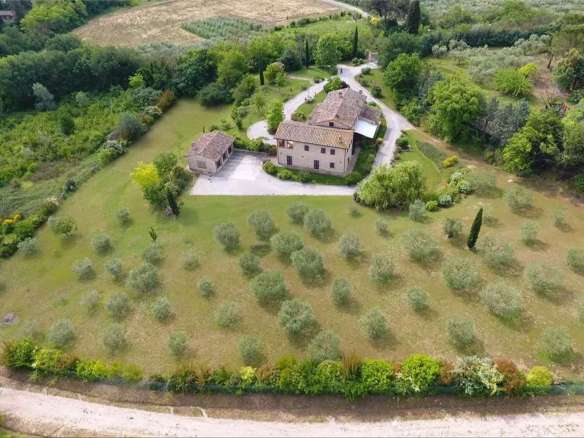
Charming Country House in Perugia, Umbria
- €1,250,000
- Bath: 1

Rustic Country House in Gosparini, Umbria
- €1,050,000
- Baths: 6